
Linking sustainable practices throughout Europe
Visit from India
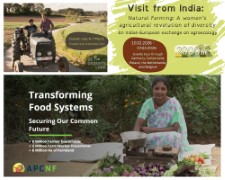 Visit from India:
Natural Farming: A women‘s agricultural revolution of diversity
Ursula von der Leyen recently referred to the trade agreement between India and the EU as the ’mother of all agreements’, stating that two giants had chosen a win-win partnership. We would now like to introduce you to two mothers from India who are developing a win-win partnership between smallholder farmers, communities and microorganisms, from which agriculture and horticulture around the world can learn a great deal.
Their Andhra Pradesh Community Managed Natural Farming (APCNF) initiative is arguably the world’s largest and fastest-growing agroecological movement. It is based on cultivating diversity, the targeted stimulation of the soil microbiome without the use of chemicals or genetic engineering, and solidarity among the women of the participating communities.
Over the last 10 years, more than a million farms (in Germany, a total of 250,000 farms are left) have adopted the nine principles of APCNF. While these principles are similar to organic principles, they also go beyond them. APCNF is successful as it immediately increases income and food security, and clearly improves the health of both people and soil.
In the 1970s, Andhra Pradesh was the heartland of high-yield rice cultivation using artificial irrigation and chemicals. However, the productivity gains of this ’green revolution’ have not overcome hunger, poverty and the excessive debt of small farmers, and they are causing ever greater damage.
Above all, ’chemical agriculture’, as it is known locally, offers no solutions to the local consequences of climate change, such as extreme heat, droughts, cyclones and floods. In contrast, APCNF women farmers collaborate with scientists worldwide to develop grassroots innovations tested and optimised in practice. Their toolkit includes new seed mixtures and biological preparations, the use of drones, and data and knowledge management using mobile phones, as well as the introduction of an additional growing season.
Learn more about this inspiring garden and field revolution from Bobbili Jyothi and Narasamma Arika, two young women farmers who each cultivate half a hectare of land and an ’Anytime Money’ kitchen garden. Incidentally, the United Nations has declared 2026 the Global Year of Women Farmers.
The tour is organised by the Weltacker (global field) coordination team at the Foundation on Future Farming (Zukunftsstiftung Landwirtschaft).
Find all about the Tour on the global field Website
Contact: info@2000m2.eu
Organised by Zukunftsstiftung Landwirtschaft (Weltacker), with the Belgian stop supported by ARC2020 and Seeds4All.
Shared and promoted by Forum Synergies.
📅 Thursday, March 6 – Meeting in Brussels
The delegation will arrive on the morning of March 6 from Wageningen University (The Netherlands).
🕒 Time: 15:00 – 17:00
📍 Location: Mundo B
Rue d’Édimbourg 26
1050 Ixelles
📅 Friday, March 7 – Visit to De Groentelaar Farm
A full day of exchange is being organised with Belgian women and men farmers, as well as various grassroots actors.
📍 Location: De Groentelaar Farm
Pepingen
Huttestraat 46, Pepingen, Belgium
This meeting will be an opportunity to discover the experiences of APCNF, as well as the fieldwork carried out by women farmers and their applied research.
For organisational purposes, could you please confirm your interest and attendance for March 7 by replying to this email, so that we can estimate the number of participants?
The caravan will be accompanied by:
• Fazia Smail, peasant baker – Atelier du Pain Vivant
• Tijs Boelens, farmer – De Groentelaar Farm, Pepingen
• Adèle Pautrat, Seeds4all Coordinator, ARC2020
• Benny Haerlin, Coordinator of The World Field, Foundation on Future Farming
• Hannes Lorenzen, President of the Agricultural and Rural Convention (ARC2020), co-organiser of the tour
The visit in Belgium will take place in English and French.
You are warmly invited to join us.
Please feel free to share this invitation with others.